
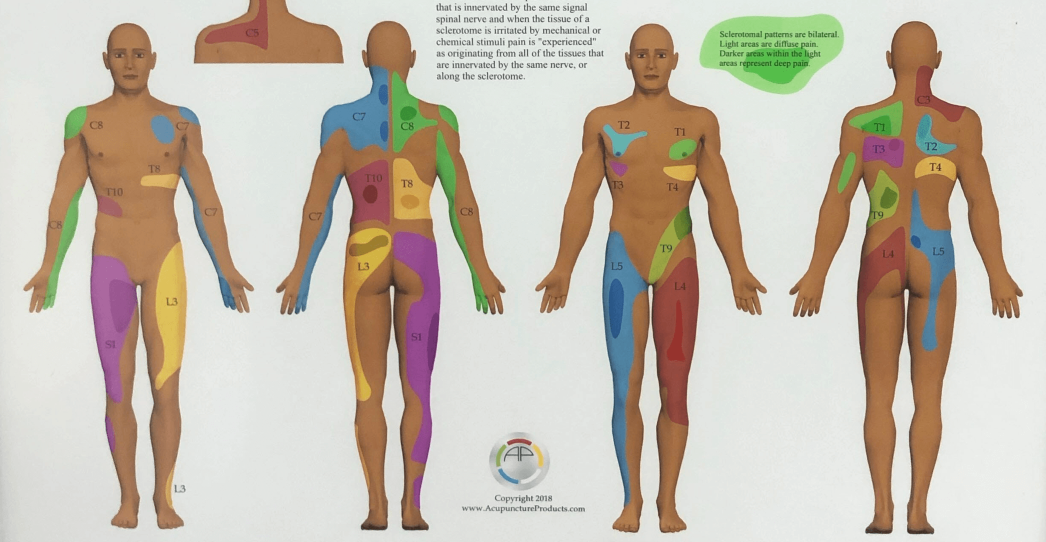
What is a Sclerotome? Understanding the Hidden Map of Referred Pain
Have you ever felt a deep, dull ache near your shoulder blade, but no matter how much you massage the muscle, it just doesn’t seem to go away? Or perhaps you’ve experienced a “toothache” sensation in your lower back that feels impossible to pin down.
In the world of clinical diagnostics, we often find that the site of the pain isn’t actually the source of the problem. To understand why, we have to look at a concept most people (and even some therapists) aren’t familiar with: The Sclerotome.
The Three Maps of the Body
To understand a sclerotome, it helps to know that during your earliest stages of development, your body organized its “wiring” into three distinct maps:
Dermatomes: The map of your skin. When you feel a “pins and needles” sensation on the surface of your leg, you are likely feeling a dermatome.
Myotomes: The map of your muscles. If a nerve is compressed and your arm feels weak, that is a myotome issue.
Sclerotomes: The map of your deep tissues (bones, joints, and ligaments).
While dermatomes and myotomes get all the attention in textbooks, sclerotomes are often the “missing link” in understanding chronic, stubborn pain.
What exactly is a Sclerotome?
A sclerotome is a specific area of deep tissue—like a disc, bone or a joint capsule—that is supplied by a single spinal nerve root.
Think of your spine as a switchboard. Each “switch” (nerve) sends a wire to a specific part of the body. The sclerotome is the deep, structural destination for that wire.
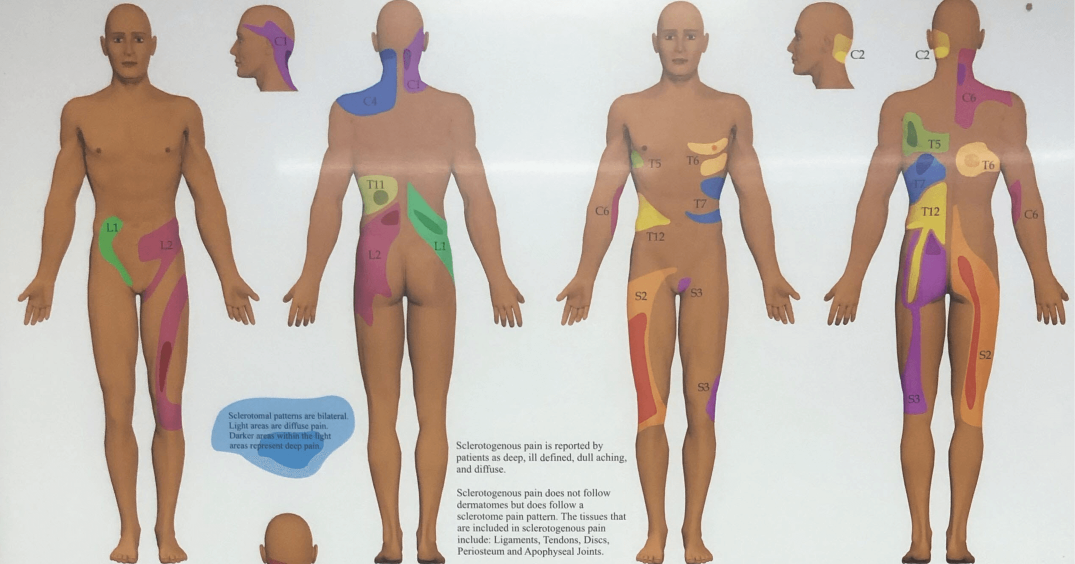
Why Sclerotogenous Pain Feels Different
If you are suffering from sclerotogenous pain, you might describe it using words like:
⚠️ Deep – that spot that no-one can get to
⚠️ A heavy, dull ache
⚠️ Vague, hard to point to with one finger
⚠️ Feels like a broad region (for example, part of the thigh or buttock)
⚠️ Unresponsive to stretching or typical massage
This is different from nerve root (dermatome) pain, which is often sharper, more electric or shooting in quality.
Because this pain is “referred” from a nerve near the spine, treatment at the painful spot provides only temporary relief—because the true source of the “alarm” is elsewhere.
The Mystery of Referred Pain
The reason sclerotomes are so important is because of referred pain.
Because your brain sometimes has trouble distinguishing exactly where a deep signal is coming from, it “projects” the pain to a different area.
The Classic Example: Most people know that during a heart attack, you might feel pain in your left arm. The heart and the arm share the same “wiring” in the spinal cord.
The Sclerotome Example: A problem with a nerve in your lower neck (the C6 or C7 nerve) might not make your neck hurt at all. Instead, it might cause a deep ache in your wrist or even your mid-back.
Why Does This Matter for Your Treatment?
If we only treated the area where you felt the symptom, we might be “chasing the ghost” of your pain and it would be unlikely to achieve sustainable relief. Treating the sore spot can feel good in the moment and may provide relief for several hours before the pain returns. But if you are reading this article, you are likely seeking a more sustainable answer.
We approach your case with a diagnostic mindset to recognise the source of symptoms, rather than just treating where it hurts.
Detailed history: Our intake process gathers important information to help recognise a sclerotome pattern.
Comprehensive examination: Our clinical evaluation uses a series of tests and hands-on palpation to test the history and confirm the diagnosis.
Pre & Post treatment testing: Where possible, we use pre & post-treatment testing to observe changes and track progress.
Summary
If you have been struggling with a deep, nagging ache that hasn’t responded to traditional treatment, you might be dealing with a sclerotome referral. Understanding that your body is a connected network is the first step toward moving without pain.
If you, or anyone that you know is suffering with chronic pain that won’t go away despite everything you’ve tried so far, please consider scheduling an Initial Consultation (link below on this page).
References & Further Reading
For those interested in the clinical science behind sclerotomes and referred pain, the following resources provide foundational evidence:
Inman, V. T., & Saunders, J. B. (1944). Referred pain from skeletal structures. Journal of Nervous and Mental Disease. (The landmark study establishing the original maps of sclerotomal pain).
Bogduk, N. (2014). On the definitions and physiology of back pain, referred pain, and radicular pain. PAIN. (A critical update on the neurobiology of referred somatic pain).
Tu, D. J., et al. (2021). The importance of sclerotomes in the clinical assessment of chronic pain. Journal of Clinical Orthopaedics and Trauma. (A recent review highlighting the relevance of sclerotomes in modern diagnostics).
Furman, M. B., et al. (2019). Atlas of Image-Guided Spinal Procedures. Elsevier. (Provides detailed anatomical correlations between nerve roots and deep tissue referral patterns).
Schmid, A. B., et al. (2018). The relationship between entrapment neuropathies and referred pain. Journal of Hand Therapy.
Merskey, H., & Bogduk, N. (Eds.). (2022). Classification of Chronic Pain: Descriptions of Chronic Pain Syndromes and Definitions of Pain Terms (3rd Ed). IASP Press.
Dr. Christopher Aysom, Principal Clinician
BChiroSc, MChiro (Chiropractor)
Apex Soft Tissue & Spine
Pymble, NSW, Australia
https://apexsofttissue.com.au